

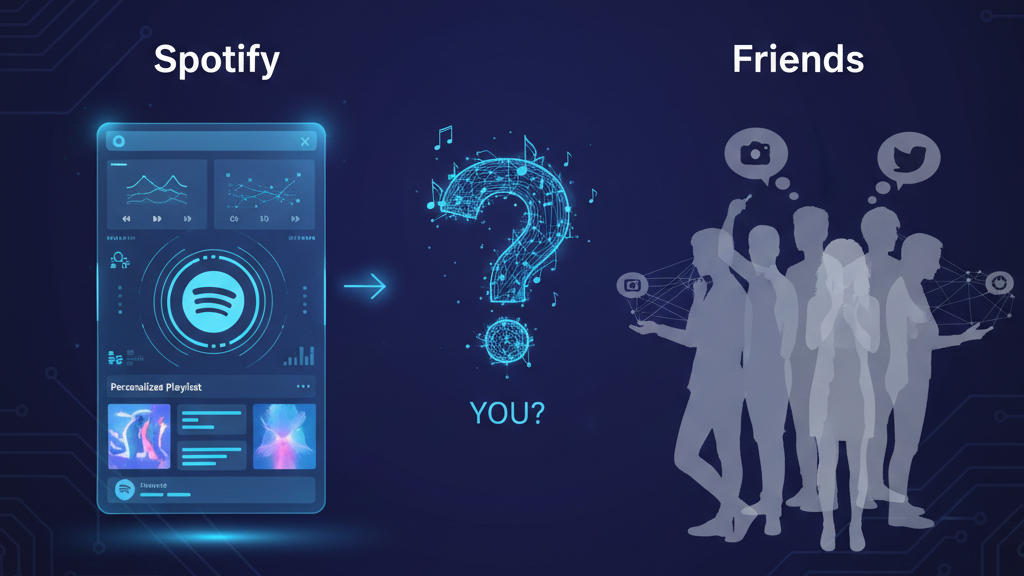
Your Discover Weekly playlist just dropped.
Twenty-nine out of thirty songs are perfect. Artists you’ve never heard of. Genres you didn’t know existed. But somehow, inexplicably, they’re your music.
How does Spotify do this?
And more importantly: why does an algorithm understand your taste better than people who’ve known you for years?
The Problem with Human Recommendations
Your friends are terrible at recommending music.
Not because they don’t know you. They do.
But they know you categorically. “You like rock.” “You’re into electronic.” “You hate country.”
Those categories are useless.
Because music taste isn’t about genres. It’s about patterns that don’t have names.
You don’t like “indie rock.” You like indie rock songs with a specific vocal timbre, tempo between 120-140 BPM, minor key, lyrics about urban isolation, and production that sounds slightly unpolished.
Your friends can’t articulate that. Hell, you can’t articulate that.
But Spotify can.
Enter: Collaborative Filtering
Spotify’s magic comes from an algorithm called collaborative filtering.
The basic idea: if you and I like 47 of the same songs, we probably have similar taste. So songs you love that I haven’t heard yet? Those might be good recommendations for me.
Mathematically, it works like this:
Step 1: Build a giant matrix.
Imagine a spreadsheet where:
- Every row is a user
- Every column is a song
- Each cell contains a rating (1-5 stars, or just “played/didn’t play”)
For Spotify, that’s 500 million users × 100 million songs.
That’s 50 quadrillion cells.
Obviously, most cells are empty. You haven’t listened to 99.9999% of all music. The matrix is sparse.
Step 2: Find similar users.
The algorithm looks at your listening history and finds users with similar patterns.
Not “users who like the same genres.” Users who liked the exact same songs in the exact same proportions.
This is where it gets mathematically beautiful.
Spotify doesn’t compare users directly. That would take too long (500 million comparisons for every recommendation).
Instead, it uses matrix factorization. It decomposes that giant sparse matrix into two smaller matrices that, when multiplied together, approximate the original.
Think of it like this:
Your music taste isn’t random. It’s driven by hidden factors. Maybe:
- Factor 1: “Moodiness” (do you like melancholy or upbeat?)
- Factor 2: “Energy” (aggressive or chill?)
- Factor 3: “Complexity” (simple hooks or intricate arrangements?)
- Factor 4-50: Other ineffable qualities we can’t name
Matrix factorization finds these hidden factors automatically. It doesn’t know what they mean. It just knows they exist.
Every user gets a “profile” across these factors. Every song gets a “profile” too.
When your profile aligns with a song’s profile, that song gets recommended.
Step 3: Predict what you’ll like.
Once Spotify knows your hidden factor profile, it can predict your rating for any song.
Even songs you’ve never heard.
Even songs that were uploaded yesterday.
Because it’s not matching you to songs. It’s matching your hidden factor profile to songs’ hidden factor profiles.
Why This Works Better Than Humans
Your friend recommends music based on explicit reasoning:
“You like Band X, so you’ll probably like Band Y.”
That’s one-dimensional thinking.
Collaborative filtering works in 50+ dimensions simultaneously.
It’s not saying “you like rock, so here’s more rock.”
It’s saying “your hidden factor profile scores 0.73 on Factor 14, 0.31 on Factor 22, and -0.18 on Factor 9, which means this song—despite being a different genre—matches your taste.”
That’s why Discover Weekly gives you songs from genres you’d never search for. The algorithm doesn’t care about genre labels. It cares about mathematical similarity in high-dimensional space.
The Cold Start Problem
Collaborative filtering has one massive weakness: new users.
When you first create a Spotify account, the algorithm knows nothing about you. It can’t compare you to similar users because it doesn’t know what you like yet.
This is called the “cold start problem.”
The solution? Hybrid approaches.
Spotify combines collaborative filtering with content-based filtering—analyzing the actual audio. They run every song through ML models that extract:
- Tempo and rhythm patterns
- Harmonic structure
- Vocal characteristics
- Timbral features
- Loudness dynamics
For new users, Spotify asks: “Pick three artists you like.”
That’s enough. Those three artists have audio profiles. Spotify finds other songs with similar audio profiles and recommends those.
As you listen, the collaborative filtering kicks in. After about 20-30 songs, the algorithm has enough data to switch from content-based to collaborative filtering.
That’s when recommendations go from “pretty good” to “eerily accurate.”
The Filter Bubble Problem
Here’s the dark side.
Collaborative filtering traps you in a bubble.
The algorithm optimizes for engagement. It learns what keeps you listening. And then it gives you more of that.
But “more of what you already like” isn’t the same as “helping you discover new things.”
Your Discover Weekly might feel adventurous, but it’s statistically calibrated to be 80% similar to your existing taste.
True discovery—finding music that challenges your taste, that expands what you think you like—gets algorithmically suppressed.
Because risky recommendations decrease engagement. And decreased engagement hurts Spotify’s metrics.
So the algorithm becomes a mirror. It shows you yourself, just slightly distorted. You think you’re exploring. Really, you’re circling the same patterns in 50-dimensional space.
The Uncanny Valley of Recommendations
There’s a sweet spot in recommendation accuracy.
Too inaccurate, and users get frustrated. Too accurate, and users get creeped out.
Research shows that people like recommendations that are 80-85% predictable. Anything higher feels invasive.
Spotify knows this.
That’s why Discover Weekly occasionally throws in a wildcard—a song that shouldn’t fit your taste but might surprise you.
It’s not a bug. It’s a feature.
Because perfect recommendations would reveal just how much Spotify knows about you. And that would be uncomfortable.
Better to be slightly wrong occasionally. Keeps you trusting the system while still being impressed.
What This Means About You
Spotify knows things about you that you don’t know about yourself.
Your music taste has structure. Patterns. Mathematical regularities.
You think you’re choosing freely. “I feel like listening to X right now.”
But that feeling? It’s predictable. Statistically.
Spotify can see it coming before you can.
Not because Spotify is magic. Because you’re more consistent than you realize.
Every preference you express is data. Every song you skip is data. Every time you replay a track is data.
And data, in sufficient quantity, reveals structure.
You are not a mystery. You are a high-dimensional vector in latent factor space.
And collaborative filtering has you mapped.
So What’s the Answer?
Why does Spotify know you better than your friends?
Because your friends think in categories. Spotify thinks in correlations.
Your friends remember the last few songs you mentioned. Spotify remembers every song you’ve ever played.
Your friends make educated guesses. Spotify makes statistical inferences across 500 million users.
And most importantly: your friends are trying to understand you.
Spotify doesn’t care about understanding.
It just cares about predicting.
The Takeaway:
Next time Discover Weekly nails it, remember: the algorithm isn’t reading your mind.
It’s reading your patterns.
And patterns, it turns out, are easier to predict than thoughts.
Which raises an uncomfortable question: if an algorithm can predict your taste from listening history alone, how much of what you think is personal preference is actually just math?