

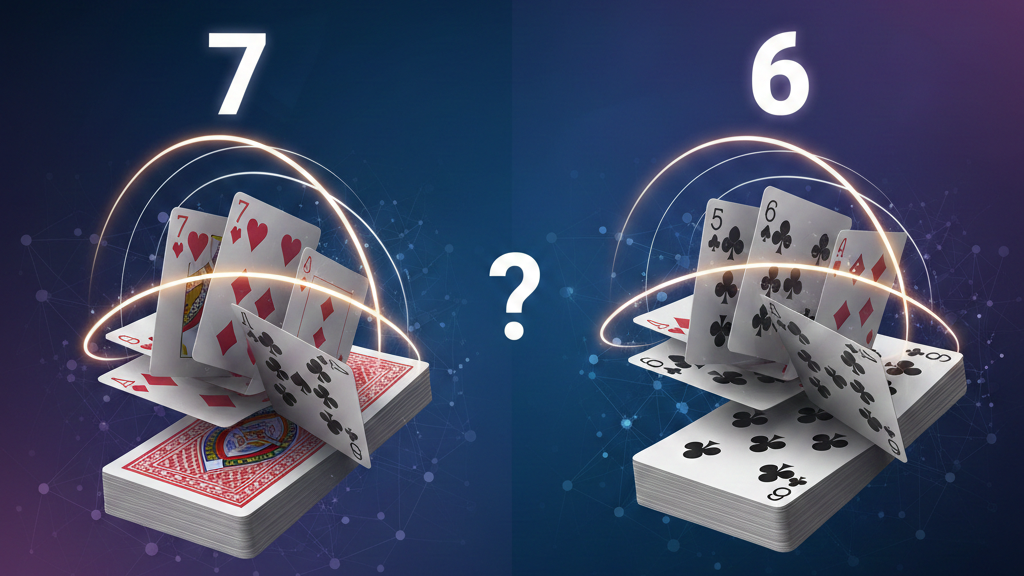
You’re at a poker table. The dealer shuffles the deck six times. Should you be worried?
Yes. And here’s why that’s terrifying.
The Problem with Almost Random
In 1992, three mathematicians—Persi Diaconis, Dave Bayer, and a lot of patience—proved something that changed how casinos operate: six shuffles aren’t enough to randomize a deck of cards.
Not “probably not enough.” Not “usually insufficient.” Mathematically, provably insufficient.
Seven shuffles? Perfect randomness. Six? You might as well be playing with a stacked deck.
The difference between six and seven isn’t marginal. It’s the difference between predictable and chaotic. And the math behind it is beautiful.
What Does “Random” Even Mean?
Before we dive in, let’s define the problem. A perfectly shuffled deck means every possible arrangement of 52 cards has an equal chance of occurring. That’s 52! (52 factorial) possible arrangements.
How big is 52 factorial?
8.07 × 10^67
That’s more than the number of atoms on Earth. More than the number of stars in the observable universe. If you shuffled one deck per second since the Big Bang, you still wouldn’t have seen every possible arrangement.
So when we say a deck is “random,” we mean that any of those 8.07 × 10^67 arrangements is equally likely. Not “close to equally likely.” Equally.
The Riffle Shuffle
The standard way to shuffle cards is called a riffle shuffle (or dovetail shuffle). You split the deck roughly in half and interleave the two halves together.
Here’s what happens mathematically:
After 1 shuffle: The deck is barely mixed. Cards that started near each other are still mostly near each other.
After 2 shuffles: Some mixing, but clusters of cards remain predictable.
After 3-4 shuffles: Getting better, but patterns persist.
After 5 shuffles: Close, but not close enough. Statistical tests can still detect non-randomness.
After 6 shuffles: Almost there. But “almost” isn’t random.
After 7 shuffles: True randomness. Every arrangement equally likely.
The Math: Rising Sequences
The proof relies on something called “rising sequences.” Imagine you go through the deck from top to bottom and mark every time a card is higher than the previous one. The number of these rising sequences tells you how well-shuffled the deck is.
A perfectly ordered deck (Ace through King, all suits in order) has exactly one rising sequence: the entire deck.
A perfectly random deck has about 26 rising sequences on average.
Here’s the beautiful part: each riffle shuffle roughly doubles the number of rising sequences.
- 1 shuffle: ~2 sequences
- 2 shuffles: ~4 sequences
- 3 shuffles: ~8 sequences
- 4 shuffles: ~16 sequences
- 5 shuffles: ~32 sequences
- 6 shuffles: ~64 sequences (wait, that’s more than 26?)
But here’s where it gets weird. After about seven shuffles, the rising sequences stop increasing linearly and start behaving chaotically. The deck “forgets” its initial order completely.
The Seven-Shuffle Threshold
Diaconis and Bayer proved that seven shuffles achieve what’s called a “separation distance” of less than 0.5 from perfect randomness. In statistical terms, that means distinguishing a seven-times-shuffled deck from a truly random deck is essentially impossible.
Six shuffles? Separation distance of about 0.92. That’s massive. A skilled card counter could absolutely exploit that.
Why Casinos Care
Before this research, many casinos shuffled decks five or six times. That was enough to “look random” but not enough to actually be random.
Professional card counters and cheats knew this. They could track clusters of high cards or exploit predictable patterns.
Now? Every major casino shuffles at least seven times. Some use automatic shufflers that riffle shuffle eight or nine times to be safe.
The difference between six and seven shuffles isn’t theoretical. It’s the difference between a fair game and one where the house (or a smart player) has a hidden edge.
The Bigger Picture: Entropy and Information
This isn’t just about card games. It’s about entropy—the mathematical measure of disorder.
Every shuffle increases the entropy of the deck. But entropy doesn’t increase linearly. It increases in bursts, then plateaus, then bursts again.
Six shuffles get you into the plateau. Seven shuffles push you over the edge into true chaos.
This pattern shows up everywhere:
- Climate models (how many iterations before weather predictions become meaningless?)
- Cryptography (how many rounds of encryption before a message is unbreakable?)
- Molecular dynamics (how long before a gas reaches equilibrium?)
The math is the same. Entropy doesn’t accumulate smoothly. It hits thresholds.
So What’s the Answer?
Why seven and not six?
Because randomness isn’t a gradual process. It’s a phase transition. Like water turning to ice, order turning to chaos happens suddenly once you cross a critical threshold.
Six shuffles leave you below that threshold. Seven put you above it.
The difference between predictable and unpredictable isn’t always obvious. Sometimes it’s just one more shuffle.
The Takeaway:
Next time you’re playing cards, count the shuffles. If the dealer stops at six, you might want to find a different table.
Not because they’re cheating. But because mathematically, they might as well be.